

The Isle of Penguins design diary 1: From complex tiles to complex boards
In The Isle of Penguins, I want you to struggle to choose the best option, not struggle to know your options.
I’ve been trying to work out the best place to start with the first design diary for The Isle of Penguins, and I thought, why not start with one of the questions that led me to creating this game?
How do you create the experience of a polyomino tile placement game without using polyominoes?
At its heart, The Isle of Penguins is about placing tiles onto your raft and using them to achieve objectives. To explain how it works, let’s start with a little bit of history.
Seven years ago, I released The Isle of Cats. Since then, with The Isle of Cats: Explore & Draw, The Isle of Cats Duel, and even Race to the Raft, the games I’ve designed with polyominoes have contained large, awkward, and complex shapes.
One of the things that stood out about The Isle of Cats was how far it pushed the tile puzzle, moving away from standard Tetris-like shapes into bigger, more unusual ones. When those tiles come out of the bag, the range of possibilities is exciting.
But while this has been widely enjoyed, there was also a challenge.
The visualisation problem
There is a group of players who can’t easily visualise tiles, rotate them, and flip them in their heads.
Some sit there worried that they don’t know which tile to take because they can’t work out where it will go. They don’t want the awkwardness of asking if they can just pick it up and try it, and they feel the added pressure of their friends watching them as they try to make it work as quickly as possible.
For many of them, this puts them off playing the game.
I want my games to be fun and enjoyable for as many people as possible, so I spent a long time thinking about how to fix this without taking away what other players love about those complex shapes.
What makes those shapes fun?
I started thinking about what makes complex shapes so enjoyable, and I think one answer is that there is no obvious place to put them.
Each time you place one, you are working towards something while creating a new problem you’ll have to deal with later. You are carving out strange spaces and trying to understand how everything can fit together in the best way possible.
So my starting point was to simplify the shapes.
What if we brought them down from those weird six-square shapes to five squares, or maybe even four? This would keep the basics of polyomino tiles, and the sort of shapes you see in a lot of other games.
But the problem for me was that the puzzle was losing some of its interest, and we weren’t fully solving the problem either.
Yes, it would be easier for people who struggle to visualise and flip tiles, but it still wouldn’t solve it entirely. If you have a five-square shape with a few bends, it can still be hard to picture.
So I wanted to take it further.
What if we went down to just squares? What if we had a square and a few basic rectangles?
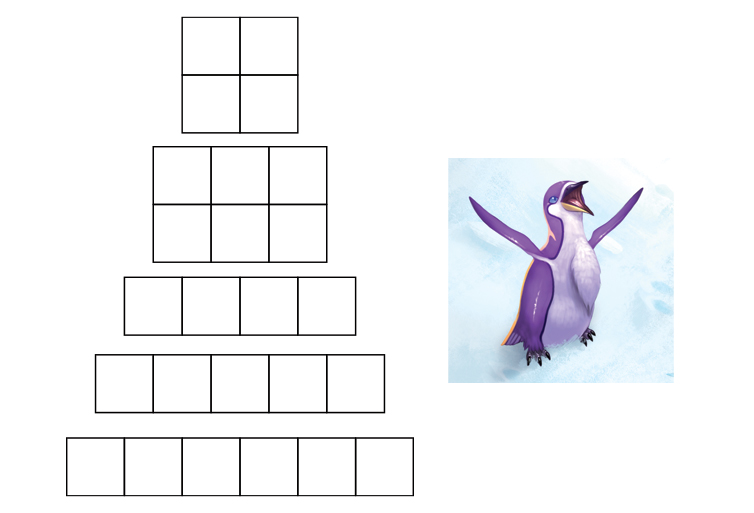
At that point, you may ask whether it is even a polyomino game anymore. By definition it is, but when you look at those shapes, it may not be the traditional polyomino game you expect.
That said, I felt this was the right direction. It is much easier to rotate a square and a simple rectangle than a more complex shape, and it immediately solves the visualisation problem.
But now we had a new problem.
If we’ve gone down to squares and rectangles, does it still have that feeling provided by complex shapes?
The puzzle moved from the tile to the board
Eventually, I realised something simple.
If I was simplifying the tiles, then I needed to complicate the board. The Isle of Cats used complex shapes on a relatively open board. The Isle of Penguins would use simple shapes on a much more awkward one.
This wasn’t about making an easier version of The Isle of Cats. It was about finding a new, more accessible way of creating a familiar satisfying puzzle.
In a sense, we’ve gone from complex shapes on a simple board to simple shapes on a complex board.
The puzzle moved from the tile to the board.
That became the heart of the design.
How the puzzle changes
Imagine a small grid with a single obstacle in the middle, and I give you 4 four-by-one rectangles and say, “Surround that object.”
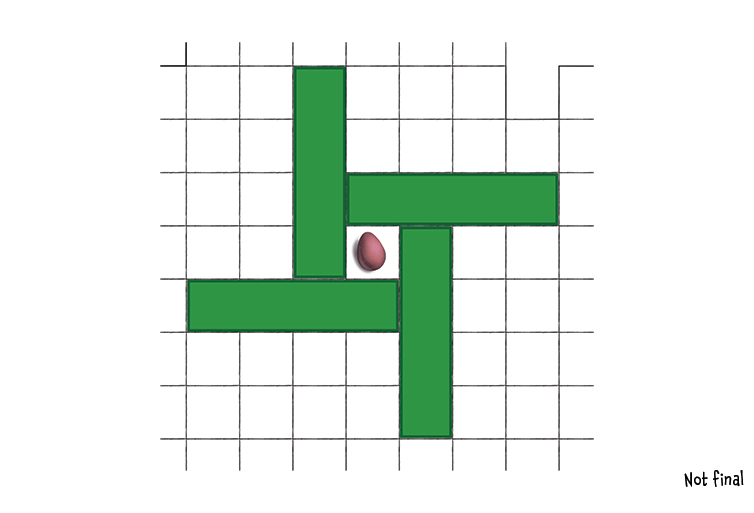
With complex shapes, you might be able to bend around it or cover multiple sides in one go. But in The Isle of Penguins, you have to work alongside it. And because all tiles must touch previously placed tiles, the moment you place one, you start creating awkwardness for yourself.
Now expand that to a larger board, with grooves, gaps, unusual shapes, and multiple obstacles.
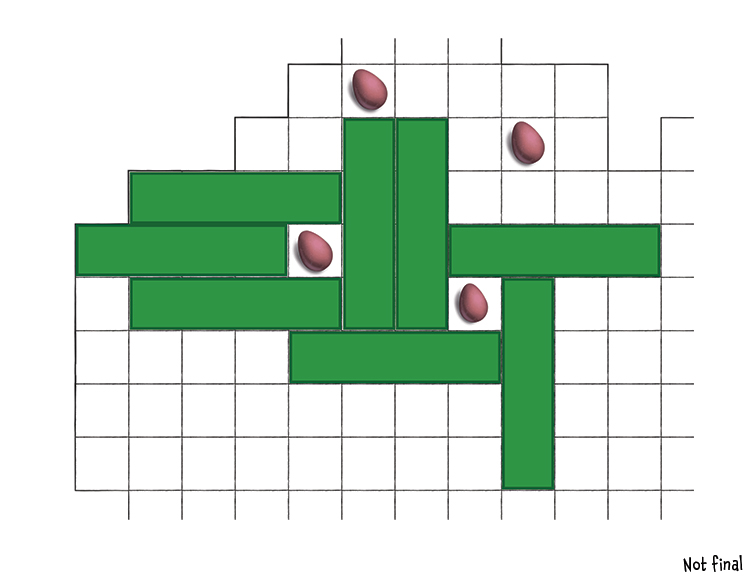
Notice in the example above, we have surrounded 2 of the 4 eggs, but the remaining eggs can no longer be fully surrounded using four-by-one rectangles.
The puzzle still exists. You are still asking yourself, “How do I place this tile, and where does it fit?”
But the challenge has changed.
It is no longer about working out how to rotate and flip a complicated shape in your head. It becomes about finding the best place to put a simple shape, and understanding what problems that choice will cause later.
If I put this long rectangle here, it helps me surround one thing, but blocks the path to another. It leaves a gap. It moves me away from a reward. It might make something harder later.
So while the tiles may look simpler, the decisions are still interesting, and the puzzle is still there.
This means players can spend less time worrying about whether they are allowed to try a tile, and more time making meaningful decisions about where it should go.
Rocks, eggs, and rewards
To help achieve this further, the raft also has various obstacles and rewards.
Rocks: Across your raft, you will have six rocks. These rocks are removable, so at the start of the game you can’t cover the spaces they are on. But if you remove a rock, you free up those spaces.
It sounds simple, but it creates interesting decisions.
Is it worth spending the time to remove a rock? Will you have the actions available before you need that space? Keeping in mind, with only squares and rectangles, working around a rock can take multiple tiles.
Eggs: Then you have the ten egg spaces, which need to be protected. To protect an egg, you need to surround all four sides. Because there are no complex shapes wrapping around corners, protecting an egg takes four penguin tiles, one on each side.
Eggs are worth a lot of points, so they give you clear goals to work towards.
Bonuses: There are also fish and boots scattered across the raft. These give you resources when covered, so you are constantly trying to move towards rewards while managing the spaces you create.
Treasure maps: Finally there are treasure maps that give bonuses when covered by specific coloured penguins.
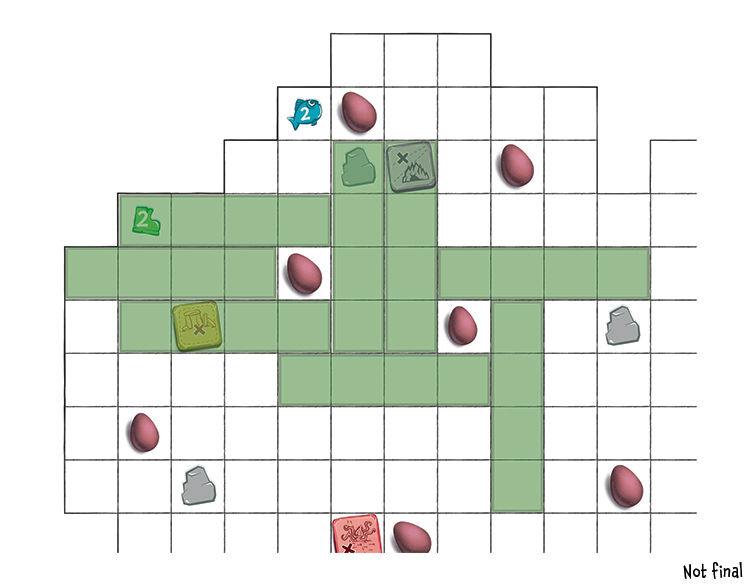
Looking back at our previous example, we placed a penguin tile over a rock, which means the placement was invalid and we would have to have found another option. We also covered some boots, giving us a bonus, and 2 treasure maps which would have required specific colour penguins. Moving forward, we’ve got more rocks and eggs to navigate, and our current state is not a good one!
So very quickly, you can see that across your raft, you have obstacles to surround, obstacles to remove, bonuses to move towards, and resources to unlock. Finally, the shape of the raft itself is chaotic, with small grooves and tiny gaps, which are challenging to navigate when you can’t go around corners.
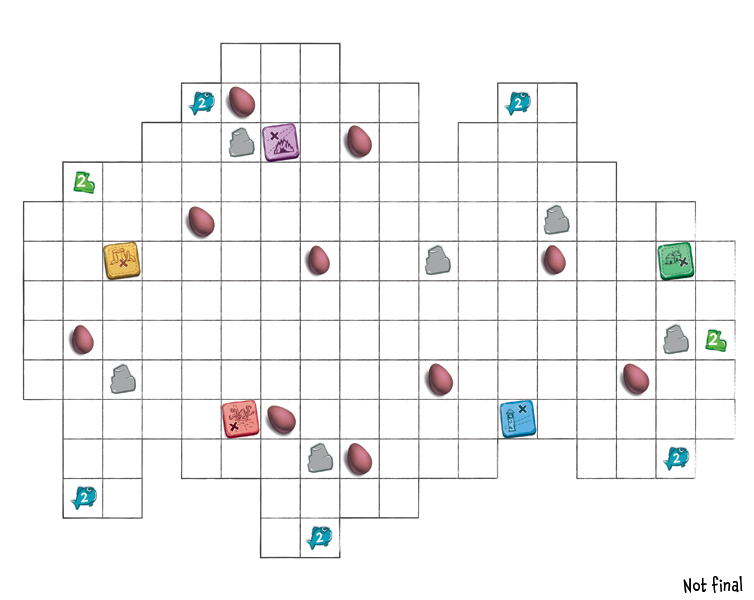
In the image above, do you see the 2 fish near the bottom in the middle, just below a rock which is next to an egg? At first glance, it feels like you should be able to collect the fish and surround both nearby eggs using 2×2 and 1×4 tiles. But once you look closer, the rock, the tile shapes, and the surrounding spaces force you to choose which goals matter most.
This is exactly the sort of puzzle I wanted The Isle of Penguins to create. The tiles are simple, but the board makes you think carefully about timing, order, and consequences.
The goal
In The Isle of Penguins, I want you to struggle to choose the best option, not struggle to know your options.
I wanted to create that puzzly polyomino feeling without the challenge of rotating and flipping complex shapes in your head.
The tiles are easier to understand, but the decisions are still satisfying, and just as importantly, they feel very different.
The puzzle is still there. It has just moved from the tile to the board.
And that means players can spend less time worrying about how to manipulate a tile in their head, and more time thinking about where it should go, what it should achieve, and what problems it might cause next.
As I continue this design diary series, I’ll talk more about the new systems in The Isle of Penguins and how the game works. In the meantime, if you have any questions, please let me know.
I look forward to sharing more soon!

Frank West
Frank West is a gamer and designer based in Bristol, UK. He published his first board game, The City of Kings, in 2018 and now works on other games and organising events in the local area. His goal? To design and publish games focusing on immersive themes, fun mechanics and beautiful components. If you have any questions or would just like a chat, feel free to get in touch at any time!