

The Isle of Penguins design diary 3: Scoring without stopping
In The Isle of Penguins, I wanted the game to end with a bang, not with admin.
For many years I’ve been watching people play The Isle of Cats, and I love the emotional build-up as the game comes to an end and players desperately try to complete their last lesson card or fill a room. But then, everything gets put on hold. Rather than seeing if it paid off, they have to spend 5-10 minutes calculating their scores.
In all honesty, it’s my least favourite part of The Isle of Cats experience. It’s not terrible, many games do it, but I wanted to try something different with The Isle of Penguins.
Scoring during the game
I started simple and brought some scoring into the game flow.
Throughout the game you will create families, protect eggs, and remove rocks. Each of these will score you points immediately.
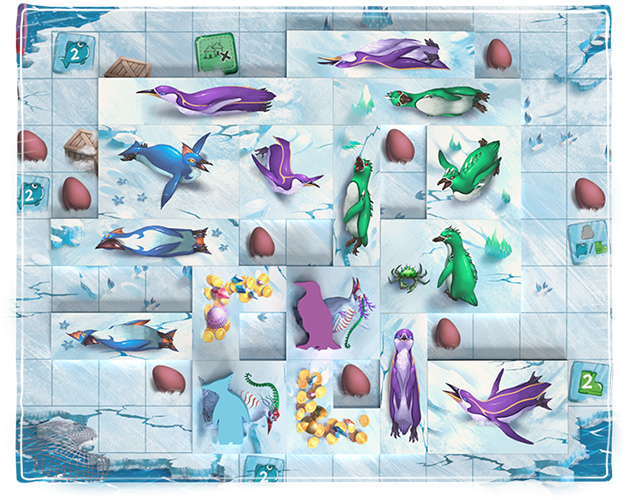
Penguin families: A family is 3 or more penguins of the same colour connected together. When you place your third green penguin into a group, you immediately score 8 points. Then, every time you add another penguin to that family, you score 3, 4, or 5 points depending on the size of the family.
Eggs: Your raft is covered in eggs. To protect an egg, all 4 sides need to be touching tiles. When you protect an egg, you immediately score 3 points.
Rocks: Your raft also starts with 6 rocks. These block spaces on your raft, and you can remove them during the game. Each time you remove a rock, you immediately score 2 points.
End-game scoring
While I wanted to remove the admin of scoring at the end of the game, it is still important that players don’t know who has won until the final turn has been played. This means some end-game scoring is important, and The Isle of Penguins does this with lesson cards.
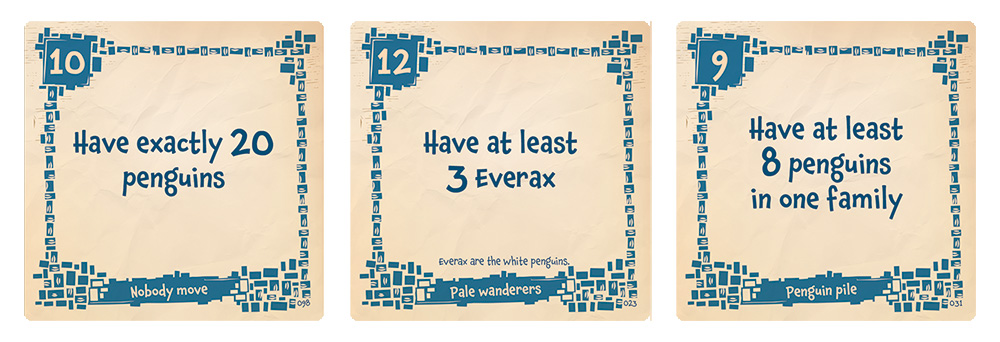
These are personal objective cards you get throughout the game and only score once the last turn has been played.
Negative points
The Isle of Cats uses negative points to create interesting decisions, and I explored this in The Isle of Penguins, but they were often dependent on the end-game state, which added more end-game admin.
In The Isle of Penguins, I decided to remove all negative scoring.
Strategic scoring
At this point, you hopefully have an idea of what scores and when. You’re also probably thinking the changes make sense, but other than removing some of the end-game admin, the game won’t feel that different. At least, that’s what I felt at this point.
I wanted to take it further and make scoring a strategic part of the game.
Around the game board you will find a score track which contains 7 score track bonuses. These bonuses are awarded to all players when a player first reaches the required score.
For example, when any player passes 36 points, all players may take 5 fish or 3 boots.
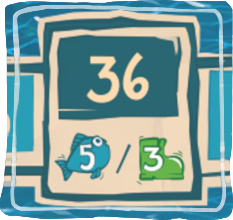
Each bonus only triggers once, but all players get it.
Imagine this situation:
- You are on 33 points.
- You need a red penguin to complete a lesson card worth 8 points at the end of the game. But placing a red penguin on your raft gives you no immediate points.
- You don’t need a green penguin for any lesson cards, but placing one on your raft will immediately give you 3 points.
The choice is 8 points later, or 3 points now, which seems like an easy decision. But, do you have enough fish for the rest of the round, or is gaining 5 fish now going to really help? Would getting 3 boots move you to first in turn order, and give you access to another area of the board?
The bonuses around the board change the value of decisions.
The bigger bonuses
Two of the score track bonuses take it a step further.
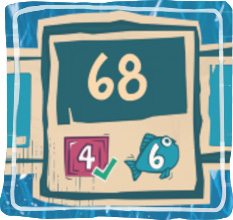
At 68 points, an additional rescue per round is added to the game. This means players will get 2 additional tiles/cards per round. Racing for early points to trigger this in round 2, or just hoping it happens at some point, can be the difference in rescuing 6 extra penguins.

At 97 points all players may take an Everax. This is a penguin that can be any colour, and can be the solution when you need just one more penguin of a certain colour. But reaching 97 points during the game is not easy, and you’ll likely have to work hard for it.
If you look back at the 3 lesson cards shown earlier in this article, getting 20 penguins, or having 8 penguins in one family, becomes a lot easier if you gain a free any-colour Everax or up to 6 extra penguins. But does the effort involved in unlocking those bonuses outweigh the benefit?
With these bonuses in place, you’ll find the optimal 8-point turn isn’t always the right thing to do. If you can get the timing of each bonus right, you can significantly increase your resources, points, and available options. You can also control the flow of the game, which can change the value of lesson cards.
I’m really happy with how this part of The Isle of Penguins has turned out. Rather than just improving the end-game experience, it has added a layer of decision making to every turn which I hope you will enjoy!
Let me know if you have any questions and I look forward to sharing my next diary.
You can find The Isle of Penguins on Kickstarter here.
You can read the other diaries here:
- The Isle of Penguins design diary 1: From complex tiles to complex boards
- The Isle of Penguins design diary 2: The game board

Frank West
Frank West is a gamer and designer based in Bristol, UK. He published his first board game, The City of Kings, in 2018 and now works on other games and organising events in the local area. His goal? To design and publish games focusing on immersive themes, fun mechanics and beautiful components. If you have any questions or would just like a chat, feel free to get in touch at any time!