

The Isle of Penguins design diary 2: The game board
In The Isle of Penguins, I wanted to create tension at the table, while removing pressure from the player.
Last week I talked about the penguin tiles in The Isle of Penguins, and how I wanted players to struggle to choose the best option, not struggle to know their options.
Today, I want to talk about the game board.
This is something completely new for The Isle of Penguins. It sits in the centre of the table and is where the open drafting takes place.
Interaction without pressure
One of my goals for The Isle of Penguins was to create two different types of moments.
I wanted moments where everyone is watching the table, caring about what other players might do, and trying to influence how the round unfolds.
But I also wanted moments where players could focus on themselves. Where they could take their time, look at their raft, place their tiles, and make decisions without everyone staring at them.
This was important to me because tile placement can be one of the slowest parts of these games. Some players see the right place immediately. Others need more time. And when other people are waiting, that can create pressure.
That pressure isn’t always fun and can slow things down even more.
So the game board was designed to create interaction during selection, then give everyone breathing room during resolution.
How the game board works
The game board is made up of ice floes.
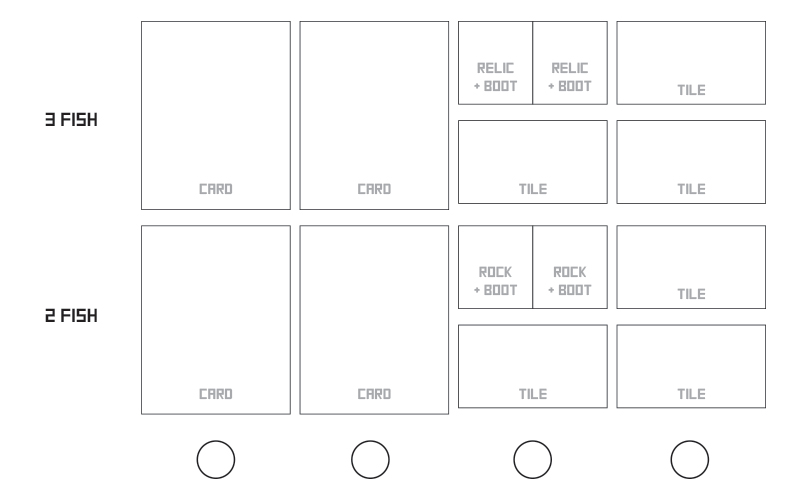
Each ice floe belongs to both a row and a column. The rows show how many fish it costs to take something from that row, while the columns create the different areas players can choose from.
The ice floes contain a mixture of things:
- Penguin tiles
- Lesson cards
- Resource generating cards
- Boots
- Rock removal
- Relics
- Other bonuses
At the start of each round, each ice floe on the board is filled. Then players go through three rescue phases.
At the start of each rescue phase, players choose columns in turn order. The first player chooses one column, then the next player chooses from the remaining columns, and so on until everyone has selected a different area.
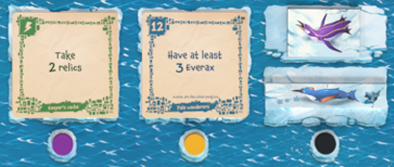
Once everyone has chosen a column, all players act at the same time.
Each player takes one thing from their column and resolves it immediately. If it is a penguin tile, they place it onto their raft. If it is a card, they place it beside their board or resolve its effect. If it removes a rock, they remove a rock immediately.
Then everyone takes a second thing from their chosen column.
This means everyone is making choices from a shared board, but resolving them at the same time.
That is the heart of the system.
Why simultaneous play matters
This approach speeds up the game.
In The Isle of Cats, you may place 14, 15, or 16 cats on your boat. In The Isle of Penguins, you may place 17, 18, or 19 penguins on your raft.
You do more in less time.
That is because players aren’t waiting while each person takes a tile, studies their board, rotates it around, places it, changes their mind, and then finally commits.
Instead, everyone has their own small set of options and resolves them together.
It also makes the experience more comfortable. You still care about what other players are doing, but you are not sitting there with everyone watching you place every single tile.
You get to make your own decisions at your own pace.
Why open information matters
One of the things I really like about this system is that everything is open.
All of the cards, tiles, and bonuses are visible to everyone. If you don’t understand a card, you can ask about it. If you want to plan ahead, you can see what is available.
There are no hidden hands of cards where someone is quietly confused and worried about asking.
Everything is public.
That means the interaction comes from planning, timing, and reading the table. In The Isle of Cats, you might have options I never had access to. In The Isle of Penguins, we are all looking at the same shared board, so I can see what you might want, what you might leave behind, and what I may need to grab first.
The question is not whether the option exists.
The question is whether you can get it at the right time.
Timing becomes the puzzle
Everything you take is resolved immediately.
If you take a penguin tile, you place it now. If you take a rock removal action, you remove the rock now.
This makes timing incredibly important.
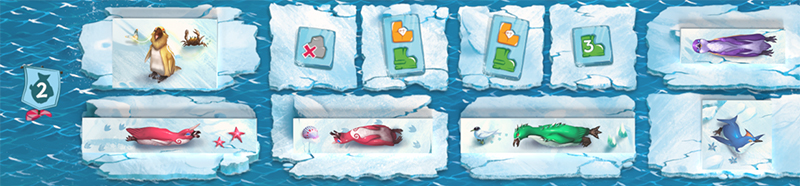
Imagine you desperately need a green penguin, but there is a rock in the way of the optimal placement. You can see an action that removes a rock in one column, and the green penguin is in another.
- Do you take the rock removal now and hope the green penguin is still available next rescue?
- Do you choose the column with the green penguin and place it in a less optimal space?
Is there another option?
These little sequencing puzzles happen constantly, but while you’re figuring out your own timing, you also need to line it up with what other players might do, or make sure you are first.
The game board gives you options, but it rarely gives you everything in the perfect order.
Boots and turn order
This is where boots become really important.
Throughout the game, you can gain boots from your raft, from ice floes, from cards, and from other bonuses.
After each rescue, turn order is updated based on who has the most boots. The player with the most boots becomes first.
But there is a cost.
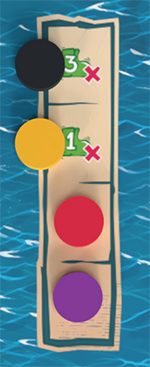
When turn order updates, the fastest players lose boots. This means that if no one gains new boots, turn order will naturally rotate around the table. Everyone gets a chance to be first.
But if you really want to be first, you can push for it.
And that’s where the tension comes in.
Being first means you get the choice of any column. If there is something you desperately need, that can be incredibly powerful. But if you spend too many actions gaining boots, you may fall behind elsewhere.
So boots become another layer of timing. You are not just asking, “What do I want?” You are also asking, “When do I need to be first?”
Reading the table
This is where the game becomes interactive in a way I really enjoy.
You are not attacking other players. You are not ruining their board. But you are watching them.
If I can see you are collecting purple penguins, and there is a column with two purple penguins and one green penguin, I can make a reasonable guess about what you might take.
Maybe that means I can safely leave the green penguin for now. But then, what if you think the same thing? We both decide to pass it this rescue and now only one of us can get it before the end of the round.
Maybe it means I need to get boots, so I can choose that column first next time.
Maybe it means I take something earlier than I wanted, just to make sure I don’t lose it.
All of this happens with open information. Everyone can see what is available, and everyone can see what other players might want.
The interaction is not about hidden tricks. It is about timing, priorities, and opportunity.
The goal
The game board in The Isle of Penguins does a lot of work.
It creates interaction without direct conflict.
It lets players care about what everyone else is doing, without forcing them to watch every placement.
It makes turn order meaningful, creates difficult timing decisions, and keeps the game moving.
For me, it’s why I fell in love with the system. You get the tension of a shared draft, while still having the comfort of placing things on your own board at your own pace.
The game board creates tension at the table, but removes pressure from the player.
If you have any questions, please let me know. I look forward to sharing more soon.

Frank West
Frank West is a gamer and designer based in Bristol, UK. He published his first board game, The City of Kings, in 2018 and now works on other games and organising events in the local area. His goal? To design and publish games focusing on immersive themes, fun mechanics and beautiful components. If you have any questions or would just like a chat, feel free to get in touch at any time!